The Court Case
1813
For four years (1809 to 1813) Archdeacon Joseph Plymley fought a court case on which his whole future rested. He was fighting distant Corbett relatives – son and daughter of a London bookseller – for the ownership of the Longnor Estate.
The problem started in the 1720s when the childless Richard Corbett took in a distant relative called Jane Flint. She was widowed as a young mother and in need of support. She moved in to Longnor Hall as his housekeeper. When he died, he left the Longnor Estate to her children, cutting out the other distant male heirs, who it seems he didn’t much like.
Jane’s sons adopted their mother’s maiden name of Corbett, but when they also died without children, the Estate passed to their sister’s son, Joseph Plymley. Joseph was a respectable man and doing rather well in the church, but it was quite a rise in fortune.
In March 1813, when he won the court case in Shrewsbury, it was his 20-year-old son, Uvedale, who was the first to get back to Longnor with the good news. Joseph’s sister Katherine reported in her diary that the church bells rang out in Longnor and Leebotwood, there were bonfires lit on every high point – including several on the Lawley – the family were cheered wherever they went, sheep were roasted, beer was drunk, and a band procession played See Where The Conquering Hero Comes. A small group from Longnor Papermill paraded to Longnor Hall with a banner, and the dancing and drinking went on for days.

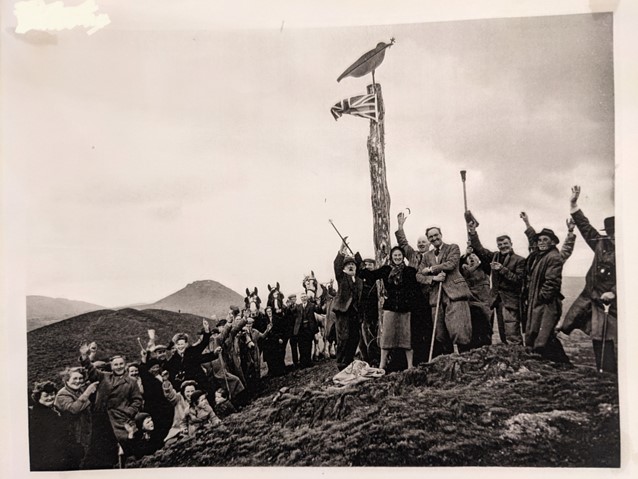
Shortly after the court victory, a procession of villagers led by a band went up to the top of the Lawley, with 12 horses dragging a flag pole. They put up the pole, fired guns into the air, and Mr Shuker who lived at the bottom of the Lawley declared it to be ‘the Pole of the Lord of the Manor’. Then the band played the National Anthem.
After the pole-raising, everyone went down to the Court House for food and a party. Katherine Plymley recorded in her diary:
“All wore the appearance of rural festivity and harmony… I was delighted to see the country fellows dancing in their smock frocks, and the young lasses whose dress bespoke them farmers’ servants… they danced with all their hearts and full of spirits.”
The celebrations went on into the early hours. Katherine learned later that she had upset some people by leaving early. So she organised another party a few days later where Richard Evans, the gardener, led the dancing by playing his violin and Richard Everall, the gamekeeper, was on the tambourine.
The pole-raising tradition still continues – these days on the eldest Corbett son’s 21st birthday.
Anti-Slavery

Longnor played an important part in the abolition of slavery. Thomas Clarkson, the prominent anti-slavery campaigner and founder of the Committee for the Abolition of the Slave Trade, frequently stayed in the village on his campaign tours.
Often travelling to Liverpool and Manchester to give lectures, or to interview sailors about conditions on board the slave ships, Clarkson would stay over with Joseph Plymley and his sister Katherine, who became keen supporters of the abolition movement. The Plymleys hosted meetings, paid for and distributed leaflets, and started their own boycott of sugar imported from the West Indies plantations. Joseph Plymley rode around the county tirelessly campaigning and gathering signatures for petitions.
Katherine’s diaries are an important record of anti-slavery activities, victories, and setbacks. You can hear her sense of injustice when writing about a court case in which a trader was acquitted of murder after whipping a slave to death…
“The papers of today inform us that Capt. John Kimber, the person mentioned by Mr Wilberforce in his speech in the House as guilty of unheard of cruelty… in the murder of a negro girl…, is acquitted and the two witnesses against him committed for perjury. The Duke of Clarence was upon the bench during the trial and afterwards went to dinner with the judges – there must be some mystery here… Mr Adams, who was in court during the trial, tells my brother there was not a shadow of doubt that he was guilty. The character of the witnesses was argued to be bad in order to invalidate their testimony.”
The Slave Trade Act of 1807 banned trading in slaves. But slave ownership didn’t become illegal in British territories until 1833. Sadly Katherine didn’t live to see this final victory.

The children at Bank House (Dower House) were involved in the anti-slavery campaigning going on around them. They too boycotted sugar, as Katherine proudly writes in her diary:
“We observ’d lately (that) Panton’s shoes look’d very brown, & on enquiry we found he had given orders that they shou’d not be black’d because he understood (that) Sugar was used in the composition.”
Katherine’s diaries report that the family tried various alternatives to West Indies sugar and encouraged friends to buy from the East Indies instead:
“from Mr Leaper (the Quaker who deals in East India sugar) we learn that great quantities have lately been imported… after paying carriage it will not come to 9d [a pound] and it is considerably superior in quality to what the grocers in Shrewsbury sell for 9d… [My brother] has ordered various sorts as samples. The loaf sugars are very good, and some of the browns the cleanest and finest I ever saw. The maple sugar has a very peculiar taste, not unlike damson jam.”
In his book about the anti-slavery campaign, Clarkson wrote a touching tribute to Joseph…
“To the Rev Joseph Plymley Corbett, Archdeacon of Salop, a most zealous and indefatigable fellow labourer in the great cause of the abolition of the slave trade and to whose active exertions that sacred cause is peculiarly indebted, this work is most gratefully and affectionately presented by the author.“
At Home with the Plymleys

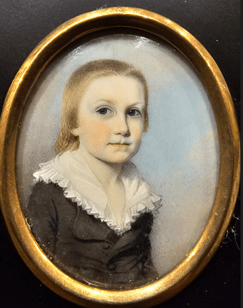
Josepha and Panton – the eldest of 12 children in the care of Katherine and her sister Ann, after their brother’s first and second wives both died young.
Katherine Plymley wrote detailed accounts of family life in Longnor, in a diary she kept for more than 30 years. More than 160 volumes are now in the Shropshire Archives.
There was a hard winter in 1814… “Robert attended the funeral of the late Mr Russell from Enchmarsh and thank GOD returned safe, but his horse twice sank into the snow, so deep that he walked off the saddle!”
In 1815 there was bad news when a servant, Matty Brown, died. “I called upon her & found her in a good deal of pain in bed, but I had often seen her apparently worse. Her old fellow servant Betty Burgess sat with her in the evening, & was helping her into bed when she suddenly called out, “my stomach, rub my stomach” & immediately expired in Betty’s arms. They had lived together full forty years at Longnor Hall. She was a woman of plain good sense & a faithful Servant.”
In 1817, 14-year-old Harriet seemed dangerously ill… “Harriet’s breathing was 200 in a minute….. Violent spasms came on between 8 & 9 o’clock at night….. the Doctor staid all night in the house, (and) I sat up with her. And Robert (her brother) remained with her till 4 or 5 o’clock. She fell asleep upon his arm when the spasms left her, & he, with the kindest patience, remained in the same posture, for tho’ she was often awake, he refused to stir lest motion bring on a return of spasms. ‘I would not stir,’ said he, ‘for £10,000’.”
Also in 1817… “Our poor old Labourer Edward Edwards died. He caught cold whilst working in his own garden…. Unfortunately he worked not in his usual strong clogs but in thin old shoes, & was taken with shiverings. I saw him several times in his short illness. He was perfectly resigned to live or die.”
The Plymleys’ was a lively household, with fascinating visitors. Katherine returned home one day to find Thomas Telford had popped in “… a man I highly respect… his conversation, his looks full of vivacity, his cheerfulness and the broad Scottish accent he retains which rather becomes him.”
Katherine was a keen painter and naturalist. A number of her paintings are in the Shropshire Archives. Amongst other things, she studied moths. “My sister, Jane, Waties and myself had all the pleasure to see the Moth burst its chrysalis; it crack’d in an instant, louder than we had before heard it, and the legs appeared struggling for freedom, in less than a minute it was entirely disengaged… The next morning we found it in high perfection and very still – I made a painting of it… The next day it was carried in a band-box to Shrewsbury as Mrs P Windsor had requested to see it… I sent it by our servant on foot… He brought it back in the evening not in the least injured by its journey.”

She also enjoyed making wine – not without incident… “I have had a narrow escape from being burnt. I was watching the boiling of some ginger wine in the furnace. The fire was rather fierce and the door of the furnace put open to damp it. As I reached over to scum the wine, my clothes caught fire. I was ignorant of the circumstance until one of the maids came in. She called out I was on fire and ran to try and put it out, but her efforts and mine were unavailing until I recollected the advice to lie down. I accordingly threw myself on the brew-house floor and then we soon extinguished the flames.”
On one occasion, Katherine took charge when her sister became ill and the doctor was delayed because of the icy roads… “I was convinced that immediate bleeding was necessary and called upon our neighbour, a farrier. He said he could bleed her but had no lancets. Happily we had, and he came directly”.
 Longnor Village History