Making the Papers
Labourer John Smith drowned near the papermill on his way home in January 1902…

In May 1902 Longnor school celebrated Empire Day…

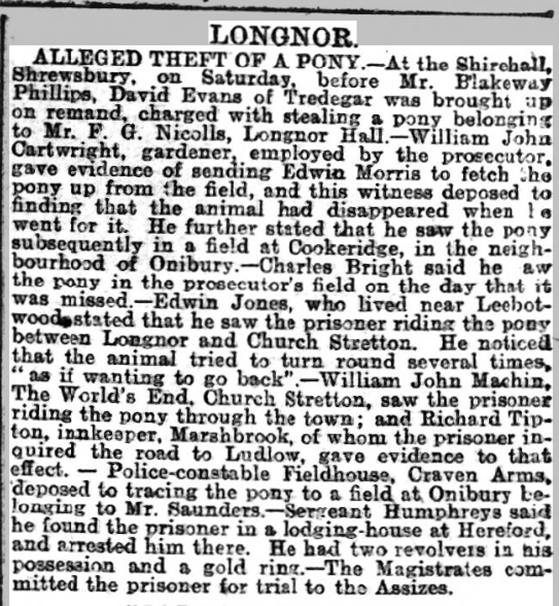
William Cartwright,a gardener in Longnor, had his pony stolen in 1901…
Everyone turned out for the funeral of Robert Dayus in 1909…

Longnor Murderer 1901
There have been several Wigley familes in Longnor. This story concerns Richard from the Wigleys who were butchers in Longnor in the 1850s and 60s. Richard was convicted of the murder of his girlfriend, Eliza Mary Bowen in 1902 and sentenced to death. Here are the notes from the court case:
Richard Wigley married in 1871, but separated from his wife and started to see Eliza Bowen in 1898.
Richard Wigley procured lodgings in Shrewsbury for Eliza Bowen. The reason he gave was so that Eliza Bowen might have a place where she could mend her clothes and get her things in order before moving on to another situation. It was noted in the murder trial that Richard Wigley had been a frequent visitor.
On 12 August 1901 Eliza Bowen moved back to the Red Lion Inn at Westbury and tried to end the affair. On 30 November 1901 Richard Wigley got up early and walked the ten miles in order to see her.
When he arrived he was served several glasses of drink by Eliza Bowen and it was said that they’d been on friendly terms. However, he was next seen with his arms around her and Eliza Bowen was heard to cry out, ‘Man, what do you mean?’, after which she said something to a servant about fetching a policeman, but she succeeded in releasing herself and no officer was sent for.
Shortly after that Eliza Bowen went from the bar to fetch some wine and on her return Richard Wigley met her and put his left arm tightly round her neck and drew a knife from his pocket. A servant girl ran off for help and got a blacksmith. By the time the blacksmith arrived Eliza Bowen was found to be reeling on the doorstep with blood gushing from a terrible wound across the front of her throat.
Eliza Bowen was said to have staggered back and fallen dead in the passage. Richard Wigley then came out and said, ‘I’ve done it, lads, for love’. When he was arrested by the police he said, ‘I have killed that little woman. It’s all for love. I loved her and nobody else shall have her’.
The start of the police report to the Secretary of State read: ‘The present case is another instance of the old and sad story: an illicit intrigue between 2 parties, the woman changes her situation, finds the old relations irksome, repels the man, a rival appears on the scene – drink, jealousy, murder’.
It was heard that the defence put forward at the trial of insanity was not only not proved, but it was disproved. When Richard Wigley was asked to plead whether he was guilty or not guilty, he replied, ‘I don’t know, I did not know what I was doing that morning’, to which the judge replied, ‘That is a plea of not guilty’. However, he was found guilty at the Salop Assizes at Shrewsbury and hanged at Shrewsbury Prison on 18 March 1902 by Henry Pierrepoint and John Ellis.
Source: http://www.capitalpunishmentuk.org/

Richard Wigley was born in Longnor in 1850. His father, also called Richard, was the village butcher. Young Richard also became a butcher. The family moved away to Shrewsbury in the 1870s, and by 1901 when the murder took place Richard was living as a lodger in a house in Berrington. He was no longer a butcher but a ‘slaughterman’.
Wigley was hanged in Shrewsbury on 18 March 1902. It was Henry Pierrepoint’s first execution as Chief Executioner.

Henry Pierrepoint’s infamous career ended in 1910 when he turned up for work “considerably worse for drink” and had a fight with his assistant John Ellis.
Public executions at Shrewsbury prison ended in 1863, so Wigley was hanged behind closed doors.

 Longnor Village History