Romans in Longnor

The Romans worked their way north after landing on the south coast in the invasion of 43 AD. At Wroxeter they built what was to become their fourth most important city.
Watling Street is a long straightish road, roughly tracing the route of today’s A2 and A5. It has a number of side shoots. At Wroxeter it split: one route north (eventually to Chester); and another south, through Acton Burnell and Longnor.
Along this route there are lots of Roman sites: a villa at Acton Scott; marching camps at Strefford Bridge and Upper Affcott near Craven Arms; and a fort at Strefford Bridge. Longnor is almost exactly halfway between Wroxeter and the marching camp at Upper Affcott, which leads some people to believe we were lunch time stop-over.
Click through below to see some Roman finds from Longnor:


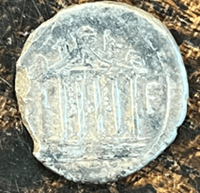
Charles Lloyd, whose father farms at The Firs, next to Watling Street, has done lots of metal detecting around Longnor. With permission from Dave and Cheryl Higgins, he scanned the big field N/W of the Longnor Green crossroads and found a much greater concentration of Roman artefacts than in other fields nearby. He believes the field must have been a Roman marching camp or market place, or both. “It must have been,” he says, “because of the amount and diversity of Roman things we’ve found there.”
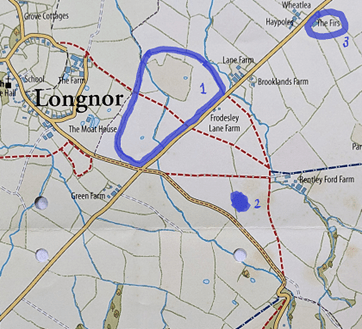
2 – Roman chariot hub caps found
3 – The Firs Farm
When Charles was about 13 or 14, he woke up in bed at Firs Farm in the early hours of the morning and could hear the “duh duh, duh duh” of hundreds of marching feet. He’s convinced he heard Roman soldiers marching along Watling St.
Caradoc’s Last Stand
15-54 AD
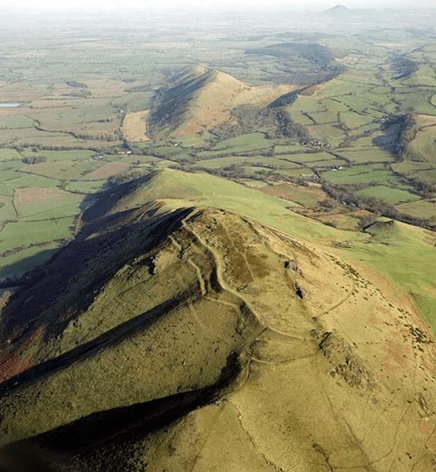
Historians debate whether the defeat of Caratacus was on Caer Caradoc or perhaps somewhere near Malvern.
A Roman historian said the army had to negotiate a ‘river’ or ‘stream’, which leads some people to believe it can’t be Caradoc.
Although there certainly is a tricky boggy area with a stream on the Ragleth side of the Caradoc, as any local walker knows.
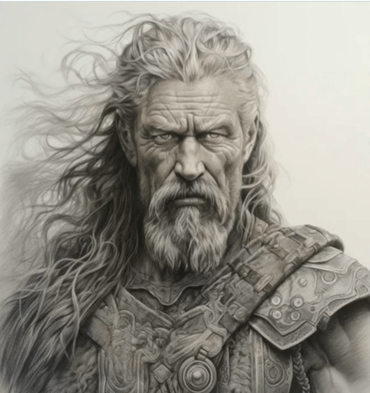
Caratacus was a charismatic British war lord. With his brother Togodumnus, he led the resistance to the Roman invasion in south-east England from 43 AD.
Caratacus fought the Romans for about seven years – carrying on after his brother’s death. It’s said he was feared and respected by the enemy. Meanwhile, some tribal leaders were surrendering or collaborating with the Romans.
Eventually Caratacus was forced to retreat northwards, and in 50 AD the Romans caught up with him. Caratacus and his followers took to a hilltop and prepared for battle.
Caratacus was defeated and his family taken prisoner. He fled to Yorkshire, where he was betrayed and handed over to the Romans. With his family, he was taken to Rome.
In Rome he was brought before the Emperor’s tribunal, and made a legendary speech:
“I am a King descended from illustrious ancestors and ruling many nations. My present situation is as glorious to you as it is degrading to myself. I could have been dragged before you like the chieftains who surrendered at the onset of the invasion. Then my punishment would have been simple oblivion. But my struggle and my downfall has brought you glory and fame. If you spare my life now, I will be a living memorial to your mercy.”
It worked, Caratacus and his family were allowed to live out their days in Rome.
In c.1750, a group of gentlemen around Longnor set up the Caractusian Society. They held dinner parties on the top of Caer Caradoc to celebrate Caratacus “sometimes accompanied by orations lauding Caratacus… By c1756 the party still ascended the hill but ate afterwards at the Bowling Green Inn in Longnor. From 1757, a poem composed by Dr Sneyd Davies was read annually at the dinner, to which 77 sat down in 1770.“
(Source: The Victoria History of Shropshire Vol. X)

Brothel Tokens
Brothel tokens are Roman coins of varying sizes depicting couples having sex – heterosexual and homosexual. On the back they have a number in Roman numerals.
Two have been found in the field at the Longnor crossroads, supporting long-held rumours that there was a Roman brothel in Longnor.
HOWEVER… Roman experts say it’s far from certain that these coins are brothel tokens. It seems there are lots of theories among historians about what they might actually be, and they’re found throughout Britain.
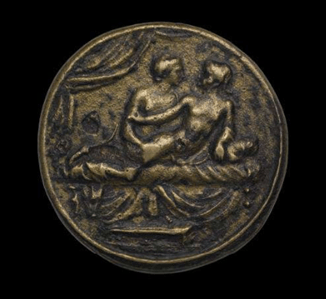

One theory relies on a record of a man being sentenced to death for carrying a coin bearing the Emperor’s image into a brothel. It’s thought maybe they developed a token system to be used instead of coins.
Another theory points to a public bath house in Pompeii which had frescoes of explicit images very similar to the ones on the coins – and also numbered with Roman numerals. As it’s known from contemporary writing that bath houses had lockers where you could leave your clothes, it’s thought maybe these were fun locker tokens.
Apparently most ‘brothel coins’ that are found are not very worn, suggesting they weren’t in mass circulation. And they were made at a single location only between about 20 –
80 AD, suggesting they didn’t have a wide or lasting use.
Some historians think they might have been used in some kind of board game.
Who knows. What we do know is that someone dropped them in Longnor. Maybe some of the Romans on their way to and from Wroxeter simply enjoyed amusing the local villagers by showing them rude images.

Historians call the coins ‘spintria’ – a word Romans used to refer to young male prostitutes. Through time, ‘spintria’ has also been used to refer to anyone involved in sexual acts considered outrageous. By the 1500s ‘spintria’ was being used to refer to these coins.
 Longnor Village History