Samuel Lee was born in Longnor in 1783, the youngest of 11 children of William Lee, a carpenter. By the time he died aged 69, he was Rector of a church in Hertfordshire, had become expert in 18 foreign languages and held one of the most prestigious academic posts in the country.
Samuel claimed he learnt very little at school in Longnor. But while working as a carpenter’s apprentice in Acton Burnell aged 17, he became intrigued by books written in a language he didn’t recognise – Latin. “I immediately bought ‘Ruddiman’s Latin Grammar’ at the bookstall and learnt it throughout.” And so began an extraordinary passion for learning. He bought a Latin dictionary next and was soon reading his way through Cicero, Virgil, Horace and Ovid.
“It may be asked how I obtained these books? I never had all at once, but generally read one and sold it, the price of which, with a little added to it, enabled me to buy another. I was now out of my apprenticeship, and determined to learn the Greek.” Over the next few years, he taught himself not only Greek but also Hebrew, Aramaic, Syriac and Samaritan.
At the age of 25, however, he sold all his books, realising that learning languages “was in my situation entirely useless”. Recently married, he turned his focus to being a carpenter. But disaster struck: “A fire broke out in the house we were repairing, in which my tools, and with them all my views and hopes, were consumed. I was now cast on the world without a friend, a shilling, or even the means of subsistence.”
Hearing of the plight of a fellow Longnor man and impressed by his earlier scholarly endeavours, Archdeacon Joseph (Plymley) Corbett used his influence to find Samuel a teaching post at Bowdler’s School in Shrewsbury. He also introduced him to Jonathan Scott, a prominent Orientalist who had recently retired to Shrewsbury. He taught Samuel Arabic and Persian and was amazed by his linguistic abilities, describing him as “possessed of talents in the acquisition of languages beyond any man I ever knew”.
Archdeacon Corbett also introduced him to the Church Missionary Society, who were equally impressed. They appointed him as their teacher of Oriental languages and agreed to sponsor his further studies at Cambridge University.
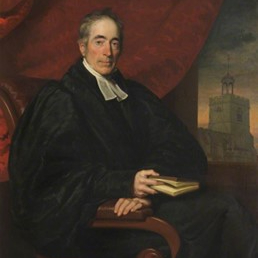
Samuel arrived in Cambridge in 1813. He took his degree in 1817, and two years later was elected Professor of Arabic and ordained as a clergyman. In 1831, he was elected Regius Professor of Hebrew, which entitled him to have his own official seat in Bristol Cathedral.
Alongside his teaching and pastoral work, Samuel devoted his life to translating the Bible and other religious texts into the languages of many parts of Asia, where they were distributed by missionaries. He was determined that people should hear about God and Christianity in their own language.
When Samuel visited Longnor in May 1820 to see his sister and old neighbours and preach in Longnor Church, Katherine Plymley wrote in her diary: “He is a distinguished honour to our village. He retains all the simplicity of manner he ever had, with the polish of good society.”

Samuel Lee’s great-grandfather, Richard Lee (born 1695) made the box pews in Longnor Church.
 Longnor Village History