The Schools of Longnor
1699 – 1984
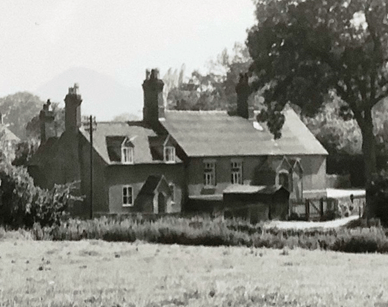
The earliest mention of a school in Longnor is in church records from 1699, which note that the curate had a school. In 1783, a charity school – or ‘dame school’ – was set up in the village, endowed by a gift in the will of Sir Richard Corbett. It was intended for the poor children of Longnor and the children of tenants on the Corbett estate in Cardington, Frodesley and Leebotwood. They were taught in the schoolmaster’s home.

A new school was built in 1871 for children aged 5 – 14. It was set up as a church school financed by the Corbett family, later with the support of a Government grant, and run by a small ‘Board of Managers’. Official Inspections took place annually; reports were generally positive, but they could be sharply worded:
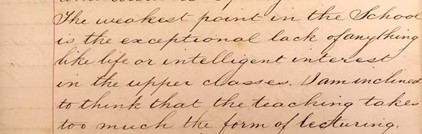
Following a tricky period during the late 1920s, when there were many changes of head, Mrs Ivy Ward arrived as Headmistress in 1931. The Inspection Report the following year was glowing:
“Mrs Ward… has secured the good will of the children and has created a home-like atmosphere.”
Mrs Ward remained in post for almost 34 years. Her assistant, Miss Duckett, who taught the Infants, served for even longer. She arrived in 1926 and retired 46 years later, in July 1972.
Longnor officially became a ‘primary school’ in April 1948, when the children aged over 11 were transferred to the new Secondary Modern School in Church Stretton.
As numbers grew, it was necessary to divide the children into three classes. But as there were only two classrooms, this meant two classes having to share a room – with no partition between them. Eventually, rather than refurbish the existing building, plans were made to build two new classrooms on the opposite side of the road.

Pupils in Classes 1 and 2 moved in to the ‘New School’ at the start of the summer term 1957 – although they had to do without a proper playground until April 1961, despite persistent requests to the Education Authority to drain, level and reseed the ground. The Infant Class remained in the ‘Old School’, where all the pupils gathered for school dinners.
In 1964, numbers at Smethcott School had fallen to just 16. It was decided that the school should be closed and the children transferred to Longnor.
In March 1971, parents met to discuss forming a Parent-Teacher Association. They decided that they favoured an informal ‘Parents Circle’. Longnor School Circle, as it became known, continues strongly today, supporting the school with fundraising and social events.
Longnor School continued on its split site until 1974, when a third classroom was added to the New School and the Infants moved across. Miss Joan Evans joined as their teacher in Jan 1979. She became Mrs Joan Beech that summer. The Old School building continued to be used for dinners until 1984.
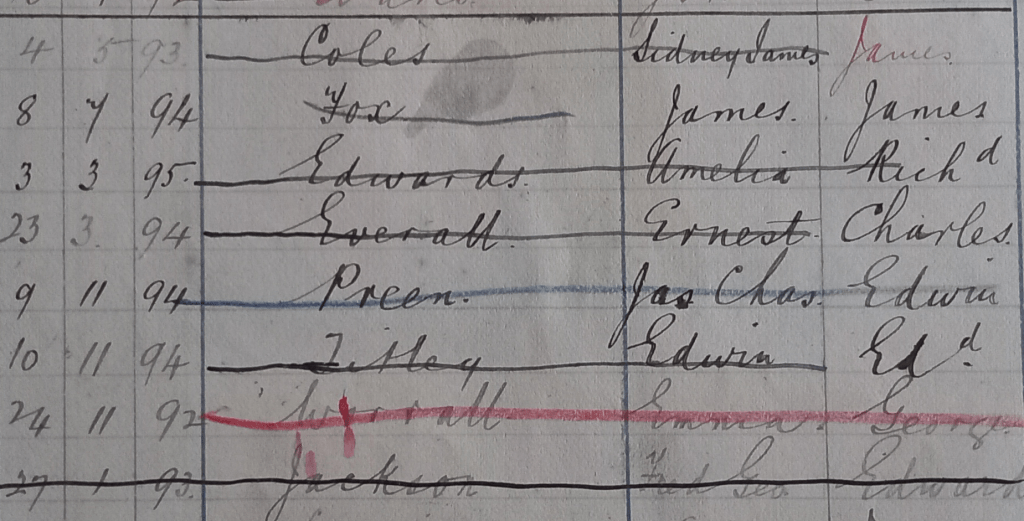
School Memories of Ernest Everall (1894-1971)

“When I started school in 1899, there was one master who taught in the big room from standard three upwards, and one mistress in the small, or classroom, as it was called. The old desks were all wood with fixed tops. The infants still had slates and slate pencils which could be wiped clean. The older ones did have pens and ink and copy books.
I think there were over 90 in the school. They were several large families in the village. Quite a lot came from Leebotwood and around the Lawley, and several from the papermill cottages. All had to walk to and from school. School time was 9am to 12 noon, with 15 minutes playtime at 11 o’clock; and from 1pm to 4pm. Some of the older boys had to act as monitors, lighting the fires, getting coal.
About the end of the summer term, we had a treat given by the Squire at the Bank House. We had tea on trestle tables under the trees in The Grove. We had each to take his own mug. The tea was provided by the local shop – home-made bread and butter, plain buns and caraway seed cake. We thought it was great. After tea, we had games and singing, and each had a packet of sweets to go home with.
The Squire had a flagpole put up at the school. On Empire Day, Waterloo Day and Trafalgar Day, we all assembled in the school yard in the morning. The best boy hoisted the flag, and the best girl lowered it in the afternoon. And each received a shilling, quite a prize in those days. I was the second boy to do this, but was not sure if it was a great honour. I believe the first to be the most mischievous boy in the school.”

Some Significant Events:
- The 1870 Education Act set up School Boards to supervise schools in every area of the country.
- In 1876 a Royal Commission recommended that education be made compulsory in order to stop child
- labour.
- The 1880 Education Act made school compulsory for all 5-10-year-olds.
- Pupils were charged fees at village schools until 1891.
- In 1891 compulsory school age was extended up to 11 years old.
- In 1893 compulsory school age was extended up to 12 years old.
- In 1901 there were still 300,000 children in England and Wales in paid work as well as going to school.
 Longnor Village History